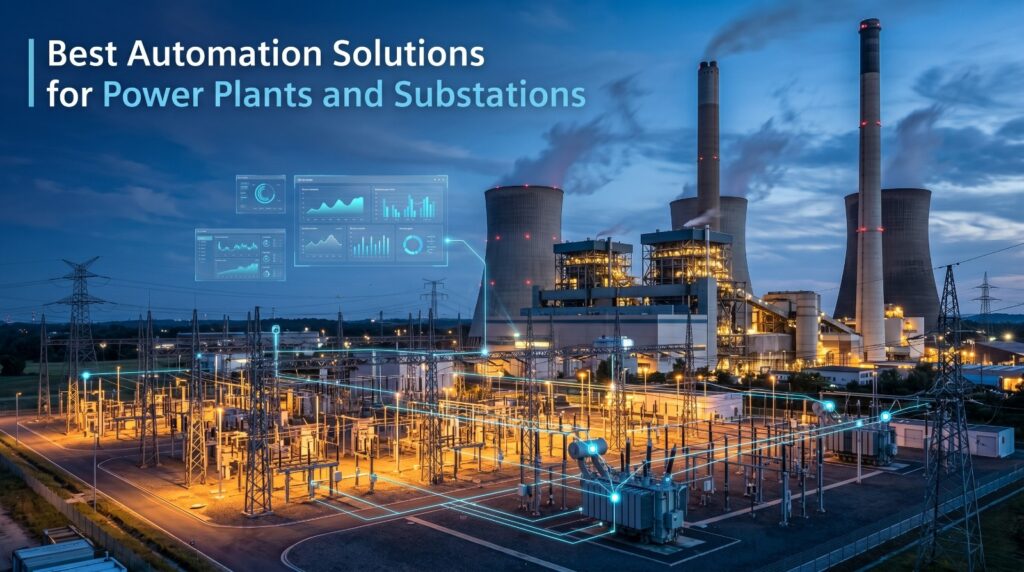
In today’s fast-evolving energy landscape, power plant automation and substation automation systems are no longer optional—they are essential for achieving operational efficiency, reliability, and grid stability.
With increasing demand for electricity, aging infrastructure, and the push toward smart grids, industries are adopting advanced industrial automation solutions to modernize their operations and ensure uninterrupted power supply.
Why Automation is Critical for Power Plants & Substations
Traditional power systems rely heavily on manual monitoring and reactive maintenance. This often leads to:
- Higher downtime
- Delayed fault detection
- Increased operational costs
- Safety and compliance risks
By implementing smart automation systems, organizations can achieve:
- Real-time monitoring and control
- Faster fault detection and response
- Improved energy efficiency
- Reduced operational costs
Key Automation Solutions for Power Infrastructure
- SCADA Systems for Real-Time Monitoring
SCADA (Supervisory Control and Data Acquisition) systems are the backbone of modern power automation.
They enable:
- Centralized monitoring of substations and plants
- Remote operation and control
- Alarm management and event tracking
- Historical data analysis
SCADA ensures better visibility, faster decision-making, and improved system reliability.
- PLC & DCS-Based Control Systems
PLC (Programmable Logic Controller) and DCS (Distributed Control System) solutions automate critical operations.
Applications include:
- Turbine and generator control
- Load management and distribution
- Protection and interlocking systems
- Emergency shutdown systems
These systems enhance process stability, safety, and precision control.
- Substation Automation Systems (SAS)
Modern substation automation solutions integrate intelligent electronic devices (IEDs), communication networks, and control systems.
Key benefits:
- Reduced manual intervention
- Faster fault isolation
- Improved grid reliability
- Seamless communication using protocols like IEC 61850
- Industrial IoT (IIoT) & Smart Sensors
Industrial IoT in power plants connects field devices and enables real-time data collection.
With IIoT, organizations can implement:
- Condition-based monitoring
- Asset performance tracking
- Remote diagnostics
- Smart energy management
This leads to data-driven decision-making and improved asset lifecycle.
- Predictive Maintenance & Advanced Analytics
Using AI-driven analytics, power plants can shift from reactive to predictive maintenance.
Key advantages:
- Early fault detection
- Reduced unplanned downtime
- Lower maintenance costs
- Increased equipment lifespan
Analytics transforms raw data into actionable insights for smarter operations.
- Energy Management Systems (EMS)
Energy management solutions help optimize power generation, distribution, and consumption.
They provide:
- Load forecasting
- Energy efficiency tracking
- Demand-side management
- Regulatory compliance reporting
Benefits of Integrated Automation Solutions
When all automation layers—SCADA, PLC, IIoT, and analytics—are integrated, organizations achieve:
- Higher plant availability
- Improved MTBF (Mean Time Between Failures)
- Reduced downtime and losses
- Enhanced safety and compliance
- Optimized energy usage
Conclusion
The future of power infrastructure lies in intelligent, connected, and automated systems.
By adopting the best automation solutions for power plants and substations, organizations can ensure reliability, efficiency, and long-term sustainability.
As the energy sector moves toward digital transformation, investing in advanced industrial automation technologies is key to staying competitive and future-ready.