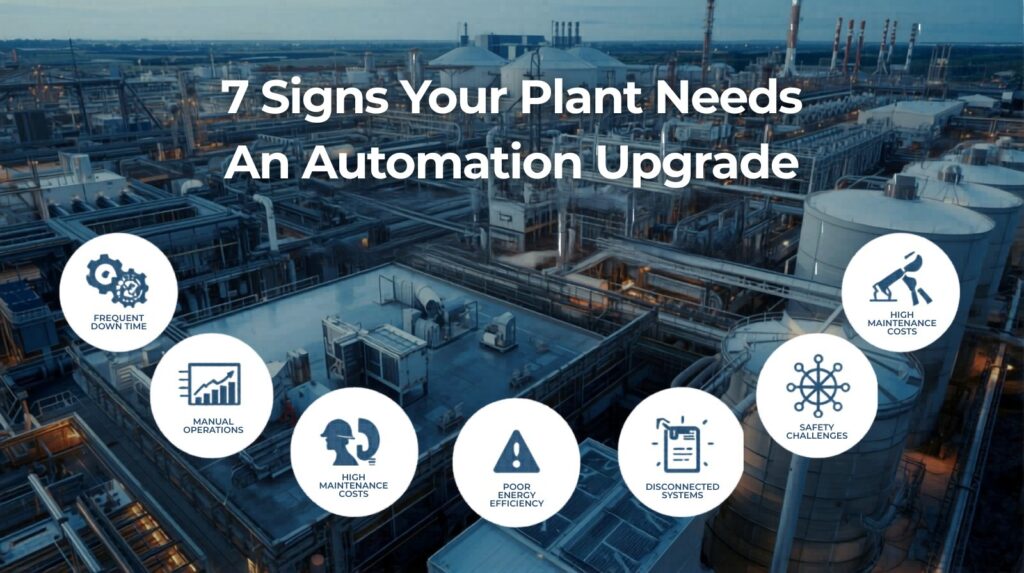
In today’s competitive industrial landscape, relying on outdated systems can significantly impact efficiency, productivity, and profitability. Modern industries are rapidly adopting industrial automation solutions to improve performance, reduce downtime, and enable data-driven decision-making.
If your plant is still operating on legacy systems, it may be time to consider an upgrade. Here are 7 clear signs your plant needs automation modernization.
1. Frequent Downtime and Unplanned Breakdowns
One of the biggest indicators of outdated systems is frequent equipment failure.
Without advanced monitoring and predictive capabilities, issues are only identified after they occur — leading to costly downtime.
Automation Advantage:
Modern systems with real-time monitoring and predictive maintenance help detect faults early, reducing unplanned shutdowns.
2.Lack of Real-Time Data Visibility
Are you still relying on manual reports or delayed data?
Legacy systems often lack real-time insights, making it difficult to monitor operations and respond quickly.
Automation Advantage:
With SCADA systems and Industrial IoT (IIoT), you get live dashboards, remote monitoring, and instant alerts — enabling faster and smarter decisions.
3.High Dependency on Manual Operations
Manual processes increase the risk of human error, inefficiencies, and inconsistent performance.
Automation Advantage:
Automated control systems such as PLC and DCS reduce manual intervention, improve accuracy, and ensure consistent operations.
4.Rising Maintenance Costs
If your maintenance costs are continuously increasing, your systems may be outdated.
Reactive maintenance leads to unnecessary repairs and higher operational expenses.
Automation Advantage:
Predictive maintenance systems analyze data to schedule maintenance only when required — reducing costs and extending equipment life.
5.Safety and Compliance Challenges
Older systems may not meet current industry safety standards and regulatory requirements.
Automation Advantage:
Modern automation ensures better safety through alarm systems, real-time alerts, and automated shutdown mechanisms, helping maintain compliance.
6.Poor Energy Efficiency
Inefficient energy usage is a major concern in legacy plants.
Automation Advantage:
Automation systems enable energy monitoring and optimization, helping reduce consumption and operational costs.
7.Disconnected Systems and Data Silos
When systems operate independently without integration, it leads to:
- Lack of coordination
- Data inconsistencies
- Operational inefficiencies
Automation Advantage:
An integrated system combining Sensors, PLCs, SCADA, and Analytics ensures seamless communication and complete operational visibility.
Why Automation Upgrade is Critical
Upgrading to modern industrial automation systems is not just a technological shift — it’s a strategic investment.
Businesses that adopt automation experience:
- Higher plant availability
- Reduced downtime
- Improved operational efficiency
- Better decision-making through data insights
- Enhanced safety and compliance
The Future is Smart & Connected
With advancements in Industrial IoT, SCADA systems, and data analytics, industries are moving toward smart plants and intelligent infrastructure.
Automation upgrades enable organizations to stay competitive, scalable, and future-ready.
Conclusion
If your plant is experiencing any of these challenges, it’s time to rethink your systems.
Upgrading your automation infrastructure can transform your operations from reactive to proactive — delivering measurable improvements in performance, efficiency, and reliability.