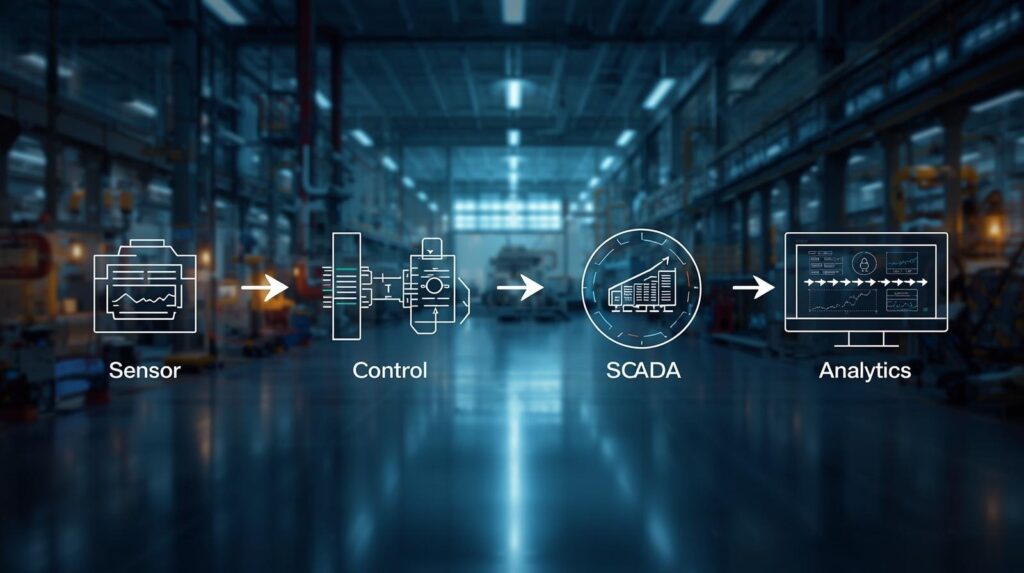
In modern power plant automation and smart infrastructure systems, operational success depends on how effectively data flows across the automation architecture.
From field-level sensors to advanced analytics platforms, a structured industrial automation data flow ensures real-time monitoring, improved efficiency, and predictive decision-making.
Understanding this flow — Sensor → Control → SCADA → Analytics — is essential for power utilities, EPC contractors, and infrastructure operators aiming to modernize legacy systems.
1. Sensor Layer: Real-Time Data Collection
Every automation system begins with field devices and sensors.
Sensors capture critical parameters such as:
- Voltage and current
- Temperature and pressure
- Flow and vibration
- Energy consumption
In power plant automation, accurate sensor data enables:
- Early fault detection
- Condition-based monitoring
- Improved safety compliance
- Continuous operational visibility
Reliable data collection is the foundation of any successful industrial automation system.
2. Control Layer: PLC & DCS Automation
Once data is captured, it moves to the PLC control system or Distributed Control System (DCS).
This layer:
- Executes automated control logic
- Maintains process stability
- Triggers alarms and protection mechanisms
- Prevents equipment damage
For power and infrastructure projects, this may include turbine control, substation automation, load balancing, and emergency shutdown systems.
Smart control systems reduce manual intervention while increasing reliability.
3. SCADA System: Centralized Monitoring & Supervision
The SCADA system (Supervisory Control and Data Acquisition) provides centralized, real-time monitoring.
It enables:
- Live dashboards
- Alarm management
- Remote operation
- Historical trend analysis
- Multi-site infrastructure monitoring
In smart power infrastructure, SCADA improves response time, reduces downtime, and enhances operational control.
4. Analytics Layer: From Data to Predictive Intelligence
The final layer transforms operational data into actionable insights.
Using Industrial IoT (IIoT) and advanced analytics, organizations can implement:
- Predictive maintenance
- Performance optimization
- Energy management systems
- Failure forecasting
- Regulatory reporting automation
Instead of reactive maintenance, power plants can move toward data-driven, predictive operations.
Why Integrated Automation Architecture Matters
When sensors, PLC systems, SCADA platforms, and analytics tools operate in silos, organizations face:
- Operational blind spots
- Increased downtime
- Higher maintenance costs
- Compliance risks
An integrated industrial automation architecture ensures seamless communication between all layers — delivering:
✔ Higher plant availability
✔ Increased MTBF
✔ Reduced downtime
✔ Improved energy efficiency
Conclusion
The automation journey from Sensor → Control → SCADA → Analytics transforms raw field data into intelligent operational decisions.
For modern power plant automation and infrastructure modernization, this structured data flow is critical to achieving reliability, scalability, and performance excellence.
Organizations that invest in advanced automation systems gain measurable improvements in efficiency, compliance, and long-term operational success.